NoSQL vs SQL Explained for Beginners: Which Database is Best?
Behind every great application is a solid foundation for storing, retrieving, and managing data. It doesn’t matter if you’re piecing together a simple blog or engineering a massive enterprise platform—the database architecture you choose early on will absolutely dictate your app’s future success.
But when it comes time to actually plan that infrastructure, developers frequently run headfirst into a major roadblock. Which database model makes the most sense? Do you stick with a traditional, strictly organized system, or do you pivot to a more modern, flexible approach?
Getting nosql vs sql explained for beginners is a crucial step to take before you write a single line of code. If you make the wrong choice now, you could be setting yourself up for crushing technical debt, sluggish app performance, and incredibly painful migrations later on.
Throughout this guide, we’ll break down the fundamental differences between these two heavyweight database types. By the end, you’ll know exactly when to reach for a relational database versus a non-relational one, how to optimize your setup, and which specific tools are worth checking out for your next project.
Why This Problem Happens: NoSQL vs SQL Explained for Beginners
Much of the confusion surrounding database types boils down to how differently modern applications handle data compared to the past. Historically, information was highly predictable and neatly structured. Early systems relied heavily on strict rules, rigid tables, and clear-cut relationships just to function correctly.
Fast forward to today, and data comes at us in countless different shapes and sizes. Modern web apps are tasked with processing staggering amounts of unstructured information—think endless social media feeds, erratic sensor logs, and unpredictable user-generated content. This rapid evolution naturally created a fundamental divide in database engineering.
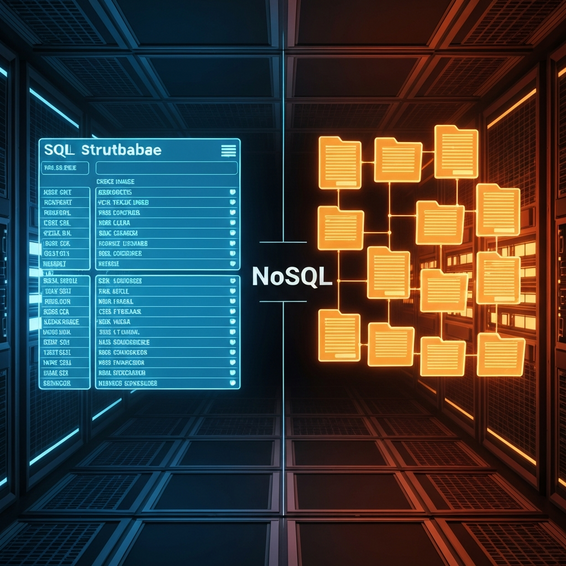
On one side, we have SQL (Structured Query Language) databases, which absolutely require predefined schemas. Before you can save so much as a single byte of data, you have to define exactly what the table will look like. While this rigid structure practically guarantees consistency, it does so at the expense of flexibility.
On the flip side, NoSQL (Not Only SQL) databases bring dynamic schemas to the table. They let you insert data on the fly, meaning you don’t have to constantly update a master blueprint just to add a new field. Ultimately, this core difference in how data is structured lies at the heart of the database dilemma.
To make matters slightly more complex, scaling requirements also play a huge role. Traditional systems typically scale vertically, meaning you have to throw more CPU and RAM at a single server to handle growth. Meanwhile, modern cloud infrastructure heavily favors horizontal scaling across multiple machines. Grasping this technical shift is your first real step toward making the right choice.
Basic Solutions: When to Choose SQL Databases
For the vast majority of standard applications, traditional relational databases are still considered the gold standard. SQL databases neatly organize information into highly structured tables made up of rows and columns, utilizing a strict schema to enforce absolute data integrity.
If your software relies heavily on complex data relationships, multi-row transactions, and unwavering accuracy, SQL is the foundational solution you’re looking for. Consider a banking application, for instance: when transferring money from one account to another, perfect synchronization isn’t just nice to have—it’s mandatory.
Not sure if SQL fits your needs? Keep an eye out for these key indicators:
- Your data is highly structured: You know exactly what fields every single record is going to have from day one.
- ACID compliance is a dealbreaker: You require strict Atomicity, Consistency, Isolation, and Durability across every transaction to prevent errors.
- You rely heavily on complex queries: Your app needs robust JOIN operations to seamlessly connect information across multiple tables.
- Your data volume is fairly predictable: You aren’t anticipating sudden, massive spikes in unstructured database writes anytime soon.
A few of the most popular SQL options out there include MySQL, PostgreSQL, and Microsoft SQL Server. These traditional engines have stood the test of time, packing incredible power and running a massive portion of the internet today.
For instance, even when you sit down to build WordPress plugins from scratch, you are leaning heavily on MySQL. It quietly handles the job of storing posts, metadata, and user profiles in a distinctly structured, relational format, ensuring that querying that data remains incredibly fast and reliable.
Advanced Solutions: When to Scale with NoSQL
As an application scales up to the enterprise level, those rigid schemas can easily transform from a safety net into a massive bottleneck. This is exactly where advanced non-relational database solutions step into the spotlight. Built from the ground up for flexibility, speed, and massive scale, NoSQL databases handle growth effortlessly.
Rather than relying on traditional tables and rows, NoSQL embraces highly flexible data models. We’re talking about document stores (such as JSON), simple key-value pairs, wide-column stores, and incredibly interconnected graph databases. From a Dev/IT perspective, this approach shifts the primary focus away from strict, unbreakable consistency, prioritizing high availability and partition tolerance instead.
It’s generally a good idea to implement a NoSQL solution once you hit these specific, advanced technical requirements:
- Rapid, agile development cycles: Your data structures are shifting so frequently that running constant database migrations would totally derail your progress.
- Massive volumes of unstructured data: You need to store incredibly varied information, such as scattered IoT sensor logs, user telemetry, or endless social media feeds.
- Strict horizontal scaling needs: Your infrastructure demands seamlessly distributing the database across multiple physical servers or global cloud regions.
- Real-time data processing: Your system requires blazing-fast read and write speeds to accommodate heavy big data analytics.
If you’re looking into NoSQL, leading examples include MongoDB, Redis, Amazon DynamoDB, and Cassandra. Each of these databases truly excels in cloud-native environments where relentless scalability is the ultimate objective.
Modern automated systems actually provide a perfect use case for this technology. For instance, as you explore how to automate daily tasks using AI, you’ll quickly notice that artificial intelligence tools frequently output massive, wildly unstructured JSON logs. A NoSQL document database like MongoDB is perfectly equipped to ingest all that raw data instantly, completely avoiding any schema-related friction.
Best Practices for Database Selection and Optimization
Selecting the right database model is, realistically, only half the battle. If you want to guarantee optimal performance and ironclad security moving forward, you still need to follow a few industry best practices—regardless of which side of the SQL/NoSQL fence you land on.
First and foremost, always make database indexing a top priority. Whether you’re firing off complex SQL JOINs or digging through a massive NoSQL document store, setting up proper indexes is the best way to prevent painfully slow, full-table scans. A well-indexed database drastically reduces query resolution times, which in turn creates a significantly smoother user experience.
Secondly, don’t be afraid to consider a hybrid approach, commonly referred to in the industry as polyglot persistence. Truth be told, large applications rarely rely entirely on a single database. It’s perfectly normal to use PostgreSQL for handling structured user accounts and billing, while simultaneously running Redis (a NoSQL tool) to manage high-speed caching and user sessions.
Finally, you can never afford to neglect basic security protocols. SQL databases are famously vulnerable to SQL injection attacks if developers fail to sanitize their inputs properly. On a similar note, NoSQL systems can suffer from their own version of injection attacks if raw user input is blindly passed directly into the query logic. To stay safe, always rely on parameterized queries and utilize secure object-relational mapping (ORM) libraries.
Recommended Tools and Resources
Ready to actually put these concepts into practice? Here are a few of the most reliable, battle-tested database platforms available on the market today. Leveraging any of these managed tools can give your day-to-day developer productivity a massive boost.
- PlanetScale: This is an incredibly powerful, serverless MySQL platform that surprisingly brings modern features like database branching and effortless scaling to the traditionally rigid relational world.
- Supabase: Widely loved as an open-source alternative to Firebase, this tool is powered entirely by PostgreSQL and offers developers instant APIs alongside seamless real-time subscriptions.
- MongoDB Atlas: Easily the premier fully-managed cloud database available for modern web applications that desperately need a flexible, reliable NoSQL document structure.
- Amazon DynamoDB: Backed by AWS, this highly scalable, serverless key-value NoSQL offering is basically tailor-made to absorb and handle massive, unexpected spikes in user traffic.
Opting to use managed cloud databases drastically reduces your underlying DevOps overhead. Instead of spending hours maintaining hardware and updating software, you can focus your energy entirely on writing core application logic.
Frequently Asked Questions (FAQ)
Is NoSQL always faster than SQL?
Not necessarily. Raw database performance depends heavily on your specific use case. It’s true that NoSQL is generally a lot faster when handling simple read and write operations across massive datasets. However, if your app requires executing complex queries that involve joining multiple tables together, a traditional SQL database will almost always be faster and much more efficient.
Can a NoSQL database replace a SQL database entirely?
While it is technically possible, doing a full replacement is rarely recommended across the board. If your application heavily processes sensitive financial transactions or relies on strict inventory management, swapping out SQL for NoSQL could easily trigger painful data consistency issues. At the end of the day, these are complementary technologies designed to solve completely different problems.
Which database type is better for big data analytics?
When it comes to initially storing massive amounts of raw information, NoSQL typically wins out thanks to its incredible ability to quickly ingest unstructured data and scale horizontally. That being said, once that data is processed and cleaned up, data analysts frequently turn to specialized, SQL-based data warehouses (like Snowflake or Google BigQuery) to actually run their complex analytics queries.
What database does Facebook use?
Facebook (now Meta) actually utilizes a sophisticated mix of both architectures. In fact, they specifically created Cassandra—a powerful NoSQL wide-column store—just to handle the massive load of users searching their inboxes. Despite that, they still lean heavily on a highly customized version of MySQL to store and manage their structured user profile data. It’s a perfect, real-world example of polyglot persistence in action.
Conclusion
Ultimately, choosing the right database architecture is easily one of the most critical foundational decisions you will make in software development. By taking the time to truly understand the core differences between structured and unstructured data, you’ll be much better equipped to build incredibly scalable, high-performance applications.
Traditional relational systems are fantastic because they provide unmatched data integrity and wildly powerful structured querying capabilities. Conversely, modern non-relational setups bring the exact kind of schema flexibility and horizontal scaling that today’s massive, cloud-native web applications demand.
Hopefully, having nosql vs sql explained for beginners gives you the clarity you need to navigate your next big infrastructure decision with total confidence. Take a step back to analyze your specific data structure, carefully evaluate your future scaling requirements, and remember—you should never be afraid to mix and match different technologies to achieve the best possible results.
About the Author